




Gum Recession Electric Toothbrush: Does It Help or Hurt?
|
3 Years |
0.45mm |
45° |
|
Duration Landmark clinical recession study |
Average Improvement Electric brush group |
Correct Brush Angle To protect the gumline |

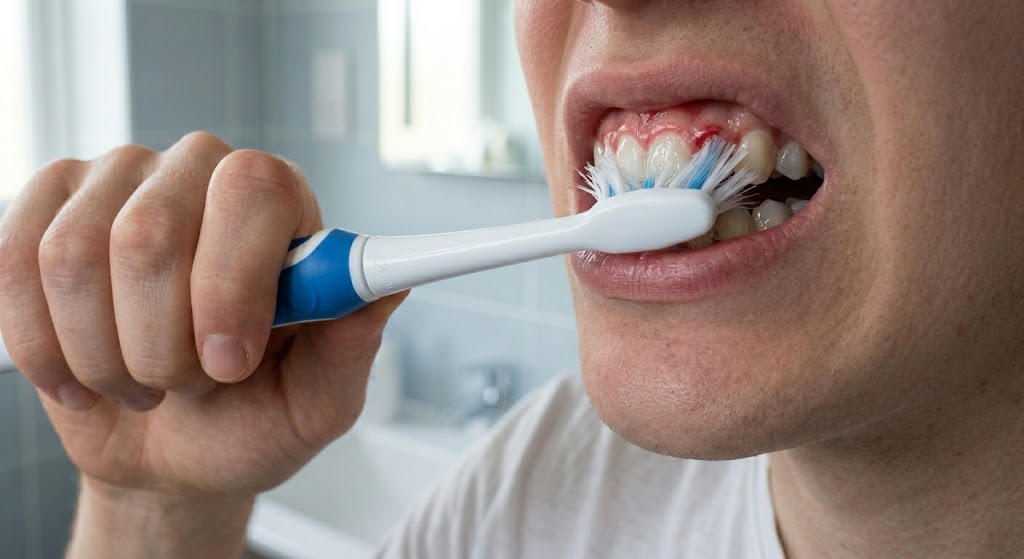
Switching to an electric toothbrush when your gums are already receding sounds counterintuitive. More vibration, more power — on tissue that's already tender? That reaction makes sense. But it's mostly wrong.
The real question was never about which type of brush you own. It's about whether you're actually using it in a way that helps rather than quietly making things worse. An electric toothbrush won't reverse recession — nothing you buy at a pharmacy will. But used right, it's one of the better tools for stopping it from getting worse. It removes the guesswork from pressure and timing, and for a lot of people, those two things were the problem all along.
This covers what recession actually is, what drives it, what happened when researchers ran a proper three-year study on people who already had it, and the specific things that matter when you're choosing and using a brush on sensitive gums.
What Is Gum Recession?

Your gums are supposed to wrap tightly around the base of each tooth. When that tissue starts pulling back — exposing more of the tooth and eventually the root — that's recession. Roots don't have enamel protecting them. Once they're exposed, they're softer, more sensitive, and much easier for bacteria to attack.
Sensitivity is usually what catches people's attention first. Cold water stings differently than it used to. Something sweet triggers a twinge right at the gumline. Then you notice one tooth looks a little longer than its neighbors — the gum line has dropped. There might be a small groove where the tooth meets the gum. None of these feels urgent on its own. But they're all signs that something has been shifting, probably for months.
Here's what you actually need to know: gum tissue doesn't regenerate on its own. Once it recedes, it stays receded. That's not meant to be alarming — it's just why the conversation always comes back to stopping it, not reversing it. Without a periodontist, reversal isn't an option.
|
Sign |
What You Might Notice |
When to Act |
|
Tooth sensitivity |
Sharp twinge in cold water, sweet food, or acidic drinks |
See a dentist if it persists for more than a week |
|
Longer-looking tooth |
One tooth appears noticeably longer than its neighbors |
Book a checkup — early recession is easiest to manage |
|
Uneven gumline |
The gum sits lower in one area than in others |
Monitor closely; photograph to track changes |
|
Tenderness at the gumline |
Soreness where the tooth meets the gum after brushing |
Reassess brushing pressure and technique immediately |
|
Notches near the gumline |
Small groove or dip at the base of the tooth |
Mention at next dental visit — can indicate abrasion |
|
Bleeding on brushing |
Blood on the brush or in the sink after brushing |
Could be gum disease or overbrushing — worth checking |
Why Gums Recede — The Real Picture

Most people assume bad brushing is the culprit. And yes — brushing technique does play a role. But it's rarely the whole story, and if you treat it as such, you'll miss whatever's actually driving the problem.
Gum disease is the most common cause, by a long way. Plaque sitting at the gumline creates irritation. That irritation becomes gingivitis. Leave gingivitis alone long enough, and it becomes periodontitis, which slowly destroys the tissue and bone supporting your teeth. As that structure breaks down over months, the gum line drops. That's not a brushing injury. That's an infection doing quiet, sustained damage.
Overbrushing is a real issue, too — especially the scrubbing side-to-side habit with a medium or firm brush. That literally grinds away the gum margin over time. But here's what most guides skip: the same brushing routine produces very different results in different people. Genetics, smoking history, bruxism, certain medications, hormonal changes during pregnancy or menopause — all of these shift how vulnerable your tissue is. Two people with identical habits can end up with completely different outcomes.
|
Cause |
How It Damages the Gumline |
Preventable? |
|
Gum disease (plaque/bacteria) |
Plaque triggers chronic inflammation; tissue and bone break down over time |
✓ Yes — with consistent plaque removal |
|
Overbrushing / wrong technique |
Physical friction wears away the delicate gum margin, especially side-to-side |
✓ Yes — with correct technique and soft bristles |
|
Hard-bristle toothbrush |
Stiff bristles create more friction per stroke, amplifying poor technique |
✓ Yes — switch to soft or extra-soft |
|
Teeth grinding (bruxism) |
Excess force on teeth stresses the surrounding gum and bone tissue |
△ Partially — night guards help |
|
Smoking |
Impairs gum healing and blood flow; masks inflammation symptoms |
△ Partially — cessation reduces risk |
|
Genetics / thin gum tissue |
Some people naturally have less gum tissue and recede faster |
✗ No — but vigilance helps slow progression |
|
Hormonal changes |
Increased sensitivity during pregnancy or menopause can accelerate recession |
△ Partially — closer monitoring during these phases |
|
IMPORTANT Knowing what's actually driving your recession matters before you focus on gear. A toothbrush — even a great one — only addresses plaque buildup and brushing technique. Gum disease, bite problems, or grinding need a dentist or periodontist, not a brush upgrade. |
How an Electric Toothbrush Can Help

It removes plaque more consistently.
Plaque is the root cause of most recessions. That sticky bacterial film drives the inflammation that eventually breaks down gum tissue and bone — and it needs to come off every single day without exception. Electric toothbrushes are genuinely better at this. The motor generates the cleaning movement; you're just positioning the head. That shift from active scrubbing to passive guiding matters more than most people expect.
An 11-year cohort study found that electric toothbrushes reduced mean probing depth — the pocket between gum and tooth where bacteria accumulate — more effectively than manual brushing over time. That's not just surface cleaning. That's a measurable improvement in the tissue surrounding each tooth.
Built-in features that change your habits
The motor itself isn't the main advantage. What actually shifts outcomes for people with sensitive or receding gums is everything built around it — pressure sensors that buzz when you're pushing too hard, two-minute timers that prevent overworking one area, sensitive modes that reduce intensity without losing cleaning power. A manual brush has none of that.
Consider someone who's been pressing hard on their gums for a decade. Pure muscle memory — they don't even realize they're doing it. They switch to a brush that flashes red and slows the motor when pressure spikes. Within days, a habit they couldn't break through awareness alone starts correcting itself. That's a genuine, practical benefit for gum protection — not a marketing point.
|
Factor |
Electric Toothbrush |
Manual Toothbrush |
|
Plaque removal efficiency |
✓ Higher — motor does the work |
△ Depends on technique and time spent |
|
Risk of overbrushing |
✓ Lower — pressure sensors alert |
✗ Higher — no real-time feedback |
|
Bristle softness options |
✓ Usually soft or extra-soft |
△ Soft/medium/hard — easy to choose wrong |
|
Brushing time control |
✓ Built-in 2-min timer |
✗ Usually guesswork |
|
Gumline angle control |
✓ Motor handles movement |
△ Fully manual — error-prone |
|
Comfort for sensitive gums |
✓ Sensitive/gum modes available |
△ No settings — fixed intensity |
|
Long-term compliance |
✓ Easier to sustain correct habits |
△ Depends entirely on user discipline |
What the Research Actually Found

There's a three-year randomized controlled trial that settles most of this pretty clearly. The researchers recruited people who already had recession, not people at risk, but people with existing, measurable recession — split them into two groups, gave one group an oscillating-rotating electric toothbrush and the other a standard manual brush, and simply told both groups to brush twice daily for two minutes—no special technique coaching. Just use your brush normally.
|
KEY FINDING Neither group got worse. In fact, both groups improved — recession shrank in both, and those gains held across the full three years. |
Electric brush group: recession dropped from 2.35mm to 1.90mm. Manual group: from 2.26mm to 1.81mm. Both were statistically significant (p < 0.001). At the individual-tooth level, the electric-brush group had a 19% lower risk of further progression (OR 0.81). Published in the Journal of Clinical Periodontology (PMC5084749), this was the first long-term controlled trial specifically looking at pre-existing recession under real-world brushing conditions.
The researchers attributed the improvement largely to the Hawthorne effect — people, knowing they're being watched, brushing more carefully. Lighter pressure, more attention, more consistency. And that's actually the takeaway. Better technique drove better outcomes. The electric brush just made it easier to maintain that technique over three years.
|
Metric |
Electric Brush Group |
Manual Brush Group |
|
Baseline recession (avg) |
2.35 mm |
2.26 mm |
|
Recession after 3 years |
1.90 mm |
1.81 mm |
|
Absolute improvement |
0.45 mm reduction |
0.45 mm reduction |
|
Statistical significance |
p < 0.001 vs baseline |
p < 0.001 vs baseline |
|
Group difference |
Not significant |
Not significant |
|
Recession progression risk |
19% lower (OR 0.81, tooth-level) |
Reference group |
|
WHAT THIS MEANS FOR YOU A properly used electric toothbrush doesn't cause more recession than a manual brush. It may actually lower the risk of things getting worse — the tooth-level data show a 19% edge. Both brush types improved when people paid closer attention to their brushing. The tool matters less than the behavior. |
Can an Electric Toothbrush Make It Worse?
Yes. But not because it's electric — because of how it's being used. Grip it tight, scrub side to side, jam the head against the gum: the motor amplifies all that friction. You get more movement per stroke than a manual brush would, and for someone with thinning tissue or exposed roots, that adds up fast.
A few months of consistent over-pressure can produce visible changes. That's not an exaggeration — the tissue at the gumline is delicate, and repeated mechanical trauma doesn't give it time to recover between sessions. The electric toothbrush didn't cause this. The habit did. It just transferred over from manual brushing without anyone catching it.
Watch your brush head. Under normal use — twice a day, two minutes — it should last around three months before the bristles visibly splay. If they're fraying at six weeks, that's a force problem. Not a brand issue, not a bristle-softness issue. You're pressing too hard, and the brush is showing you.
|
Warning Sign |
What It Tells You |
What to Do |
|
Brush head fraying in <8 weeks |
Pressing too hard — normal use = 3 months |
Reduce pressure; use pressure sensor mode |
|
Gums are sore after brushing |
Friction irritation — common in overbrushing |
Switch to gentle mode; check bristle softness |
|
Increased sensitivity at the gumline |
Enamel or root surface irritation is building |
See a dentist; review technique and pressure |
|
Bristles splayed outward early |
Force, not time, is wearing the head out fast |
Treat the brush as a feather — no grip pressure needed |
|
Bleeding is tied to pressure |
Not disease-related — physical trauma from force |
Stop scrubbing; guide the brush instead |
|
WATCH OUT An electric toothbrush used with a hard grip and scrubbing motion does more damage than a gentle manual brush. The motor multiplies whatever technique you bring — good habits or bad ones. If sensitive spots feel aggravated after brushing, reduce pressure before switching to anything else. |
The Right Brushing Technique

Most people don't brush catastrophically wrong. They're just slightly too forceful, slightly too rushed, lingering a little too long in the same spot. Over the years, "slightly" becomes "recession," showing up at 40 after starting at 28.
With an electric brush, the actual fix is straightforward: stop scrubbing. The head is already moving — your only job is to hold it at roughly 45 degrees to the gumline and slide slowly from one tooth to the next. One to two seconds each. That's genuinely it. The bristles settle into the sulcus on their own. Pushing them in harder doesn't help. That's exactly what causes problems.
|
Step |
Action |
Why It Matters |
|
01 |
Use soft or extra-soft bristles; engage sensitive/gum mode if available |
Less friction per stroke = less gum irritation over time |
|
02 |
Hold the brush at a 45° angle to the gumline |
Allows bristles to clean the gum margin without digging in |
|
03 |
Rest bristles against the tooth — do not push or press |
The motor provides all the cleaning force; your hand just guides |
|
04 |
Glide slowly from one tooth to the next; 1–2 seconds per tooth |
Prevents staying too long in one spot and overworking sensitive tissue |
|
05 |
Outer surfaces first, then inner, then chewing surfaces |
Systematic order ensures nothing gets over-cleaned or skipped |
|
06 |
Two minutes total, twice daily — use the built-in timer |
Enough to clean thoroughly; longer doesn't mean better for receding gums |
|
07 |
Floss or use interdental brushes before or after |
Electric brushes don't reach between teeth — plaque there causes recession too. |
|
QUICK RULE Hold the brush like a pen — not like a scrubbing brush. Feeling a strong vibration transmitted through your teeth means you're pressing too hard. The bristles should glide along the surface, not push into it. |
What to Look for in a Brush
The priciest brush on the shelf isn't automatically the right one for receding gums. What you actually need is narrow: a pressure sensor, soft bristles, and a sensitive or gum-care mode. Those three features address the three most common ways brushing worsens recession. Bluetooth, seven cleaning modes, a companion app — those are nice-to-haves. They're not what protects your gumline.
|
Feature |
Why It Matters for Receding Gums |
Priority |
|
Soft / extra-soft brush head |
Less friction at the gumline — the most direct protective measure you can take |
✓ Essential |
|
Pressure sensor |
Alerts you in real time when force exceeds safe threshold; retrains habits fast |
✓ Essential |
|
Sensitive or gum care mode |
Reduces motor intensity without sacrificing plaque removal; more comfortable |
✓ Essential |
|
2-minute timer + quadrant pacer |
Prevents over-brushing in one area and under-brushing in another |
✓ Recommended |
|
Ergonomic, comfortable handle |
A secure grip reduces the urge to squeeze or apply extra force unconsciously |
△ Helpful |
|
Easy-to-replace brush heads |
Fresh heads maintain bristle softness; worn heads are harsher on gums |
△ Helpful |

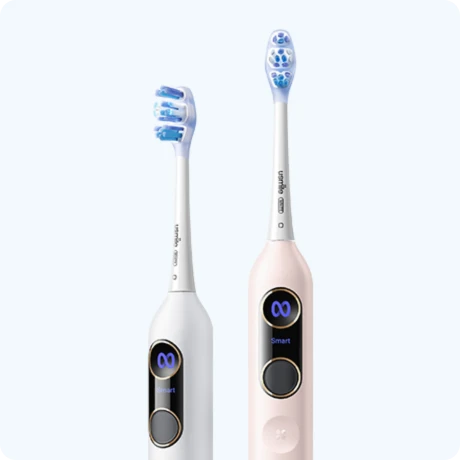
An AI electric toothbrush with a built-in pressure sensor and a sensitive mode covers everything on that list without overcomplicating. You don't need to spend a lot. You need the right few features and the habit of using them daily. That combination beats better hardware used carelessly every time.
Oral-B or Sonicare for Receding Gums?
 Honestly, either works. Both brands make brushes with the features that matter for sensitive gums. The difference comes down to feel — and when you've got tender gumlines, that's not a trivial thing to brush off.
|
Factor |
Oral-B (Oscillating-Rotating) |
Sonicare (Sonic Vibration) |
|
Motor type |
Small round head rotates back and forth at ~8,800 strokes/min |
Oval head vibrates at ~31,000 strokes/min (up to 62,000) |
|
Sensation on gums |
More mechanical, "scrubbing" feel |
Gentle humming/tingling — often preferred by sensitive users |
|
Head size |
Smaller, round — easier to maneuver individual teeth |
Larger oval — covers more surface per pass |
|
Pressure sensor quality |
Smart Pressure Sensor on iO models — light + heavy alerts |
Pressure sensor on ProtectiveClean + above — light only |
|
Sensitive mode |
Available on iO Series and above |
Available on 4100, DiamondClean, ProtectiveClean |
|
Best for receding gums |
High control users; those who prefer a precise feel |
High sensitivity users; those who find vibration gentler |
|
Key drawback |
A smaller head may feel more intense on very tender spots |
A larger head can feel less precise in tight spaces |
Sonicare vibrates at far higher frequency — it tends to feel lighter, more like a hum than a scrub. That's often the more comfortable experience for people whose gums are very tender across the whole mouth. Oral-B's smaller round head spins and gives you much finer positional control — useful if recession is concentrated around a few specific teeth where precision matters. Try both if you can manage it. A week with each and your mouth will tell you which one you'll actually stick with long-term.
Can Receding Gums Grow Back?
No — and that's worth sitting with for a moment. Gum tissue doesn't heal as skin does. Once it pulls back and the underlying bone shrinks, there's no natural mechanism to rebuild either. That's not a small caveat. It's why prevention matters so much more than any product you could reach for after the fact.
Consistent daily care can reduce the inflammation that was driving the recession. When gum disease is the main cause, controlling plaque well enough often lets the tissue firm up and sit more snugly around the tooth — periodontists call this creeping attachment. It looks like an improvement, and in a functional sense, it is. But it's existing tissue calming down, not new tissue growing in.
Exposed roots, visible bone loss, gumlines that have dropped far enough to cause sensitivity or pain — those situations need professional treatment. A toothbrush has a ceiling, however good it is.
|
✓ |
Daily brushing (correct technique) — Removes plaque, reduces inflammation, stops progression. Always the first line of defense. |
|
✓ |
Professional cleaning — Removes hardened tartar below the gumline that brushing can't reach. Every 6 months minimum; every 3–4 months if recession is active. |
|
✓ |
Gum grafting — Transplants tissue to cover exposed roots. Used for significant root exposure, chronic sensitivity, or bone involvement. |
|
✓ |
Pinhole Surgical Technique — Stretches existing tissue over recession areas without grafting, for moderate cases without major bone loss. |
|
✓ |
Desensitizing sealants — Seals the exposed root surface to reduce sensitivity. Short-term relief while other treatment is planned. |
FAQs
Can electric toothbrushes cause gums to recede?
They can — but the culprit is how it's being used, not the fact that it's electric. Gripping hard, scrubbing side-to-side, pressing the head into the gum: the motor amplifies all of that. You end up doing more damage per stroke than a manual brush with the same bad habits. Used right — soft head, no pressure, sensitive mode on — an electric brush is generally easier on sensitive gums than manual brushing. The motor does the work. Your job is to stop trying to help it.
Which electric toothbrush is better for gum recession?
Three things: pressure sensor, sensitive or gum-care mode, soft brush head. That's the actual list. Brand is secondary to those features. Sonicare tends to feel lighter and less mechanical — often better if sensitivity is spread across the whole mouth. Oral-B's smaller, round head provides more control when the recession is concentrated around specific teeth. Both are fine if you use them correctly.
How do I brush to prevent gum recession?
Hold the brush at 45 degrees, aimed at the gumline — not flat across the teeth. Rest the bristles against the surface and let the motor do the movement. Slide slowly from tooth to tooth, about a second or two each. Two minutes total, twice a day. Then floss, because electric brushes don't reach the spaces between teeth, and that's where a significant portion of recession-causing plaque actually hides. The habits themselves aren't complicated. Keeping them as part of a real oral care routine is what makes them stick.
What's the worst thing for receding gums?
Leaving plaque on your teeth day after day. That quiet accumulation feeds the chronic inflammation that slowly destroys gum tissue and bone — often with very little pain until real damage is already done. Close second is scrubbing hard with a medium or firm brush. That physically wears the gum margin down over time. Both are preventable—neither repairs itself.
Can receding gums grow back?
Not on their own. The body doesn't regenerate gum tissue the way it closes a cut. You can stop the progression — and in some cases, as inflammation drops, existing tissue firms up and sits better around the tooth. But for actual restoration, covering exposed roots or addressing bone loss, you're looking at a graft or the Pinhole Surgical Technique. That's a conversation with a periodontist, not a brushing one.
Oral-B or Sonicare — which is better for recession?
Neither has a clear edge. Sonicare is usually more comfortable if high sensitivity is the main issue — the vibration feels lighter and less like scrubbing. Oral-B's round head is smaller, which helps when you need precision around specific teeth. Both require a soft head and a pressure sensor tactually to protect receding gums. Get those features right first; the brand becomes much less important.
Do teeth fall out with receding gums?
Not automatically, no. Recession from overbrushing, where the underlying bone is intact, leaves teeth very stable. Plenty of people live with some recession for decades and keep every tooth. Tooth loss becomes a real risk when recession is driven by periodontitis — that disease eats the bone anchoring each tooth. If teeth feel loose, are shifting position, or bite differently than they used to, bone loss is likely involved. That's the line between monitoring the situation and seeing a periodontist urgently.
What are Stage 4 receding gums?
Stage IV Periodontitis — the most advanced level in the AAP classification system. Substantial bone loss, widely exposed roots, teeth that may be mobile or shifting, and chewing that often becomes painful. No toothbrush manages Stage IV. It needs a periodontist, full stop. If you're looking this up because something in your mouth changed noticeably over a short period, book an appointment before anything else.
The Bottom Line

Gum recession usually creeps up slowly. Most people don't notice until something is already worth addressing. The good news is that for the majority of cases — where brushing habits and plaque are the main drivers — the fix is genuinely manageable.
An electric brush with a pressure sensor and soft head takes two of the most common mistakes — pressing too hard and spending too long in one spot — and largely corrects them automatically. The three-year study showed that both electric and manual brushes improved pre-existing recession when people paid attention to technique. The electric brush had a modest edge in tooth-level progression risk. Neither type made things worse.
Pick a brush with the right features. Use it gently, at 45 degrees, without pressing. Floss. Get professional cleanings regularly. If your gumline is changing quickly or recession is already significant, see your dentist — some causes of recession won't respond to better brushing, no matter what brush you own. But for everyday protection, this is essentially the whole playbook.
|
5 THINGS THAT ACTUALLY PROTECT RECEDING GUMS 1. Soft or extra-soft bristles — the single most direct protective choice you can make. 2. Pressure sensor — real-time feedback corrects the overbrushing habit faster than anything else. 3. 45° angle + zero pressure — rest the brush against the tooth. The motor handles the rest. 4. Two minutes, twice daily — distributed evenly, not spent grinding one spot. 5. Regular professional cleanings — tartar below the gumline can't be brushed away. |
References
- National Institute of Dental and Craniofacial Research (NIDCR). Oral Hygiene.
- National Institute of Dental and Craniofacial Research (NIDCR). Periodontal (Gum) Disease.
- National Institute of Dental and Craniofacial Research (NIDCR). Ask the Expert: Do I Really Need to Floss?.
- American Dental Association (ADA). Toothbrushes.
- American Dental Association (ADA). Home Oral Care.
- Dörfer CE, Joerss D, Rau P, et al. Three-year randomized study of manual and power toothbrush effects on pre-existing gingival recession. Journal of Clinical Periodontology. 2016.
- Thomassen TMJA, et al. The efficacy of powered toothbrushes: A systematic review and network meta-analysis. International Journal of Dental Hygiene. 2022.
- American Academy of Periodontology (AAP). Gum Disease Information.
- American Academy of Periodontology (AAP). Gum Disease Risk Factors.
- Yaacob M, et al. Powered versus manual toothbrushing for oral health. Cochrane Database of Systematic Reviews. 2014.


Looking for something else?
Best Electric Toothbrush for Gum Disease (2026): 6 Picks Tested for Real Gum Protection
LEARN MORE
Electric Toothbrush on Plane: The Complete Travel Guide (2026)
LEARN MORE
Best Cheap Electric Toothbrush (2026): Top 5 Budget Picks That Actually Work
LEARN MORE
Ultrasonic Toothbrush vs Electric: Which Technology Wins for Your Smile?
LEARN MORELooking for something else?
Best Electric Toothbrush for Sensitive Teeth (2026) — 5 Tested
LEARN MORE
Does an Electric Toothbrush Have a Lithium Battery
LEARN MORE
How to Make Brushing Teeth Fun for Kids Without Daily Battles
LEARN MOREYou may also like

usmile C30 Cordless Water Flosser – Portable Oral Irrigator

usmile Y20 PRO Upgraded AI Electric Toothbrush

usmile P10 S Electric Toothbrush

usmile Q30 Kids Electric Toothbrush
usmile C30SE Portable Dental Flosser
usmile Q30 Kids Electric Toothbrush Trio Pack
Further reading

Why Teeth Look More Spaced Out After Water Flossing
Best Sustainable Electric Toothbrush 2026: 5 Picks Tested for a Greener, Healthier Smile
Plaque, Stains, or Food Debris? How to Interpret What a Toothbrush Camera Shows