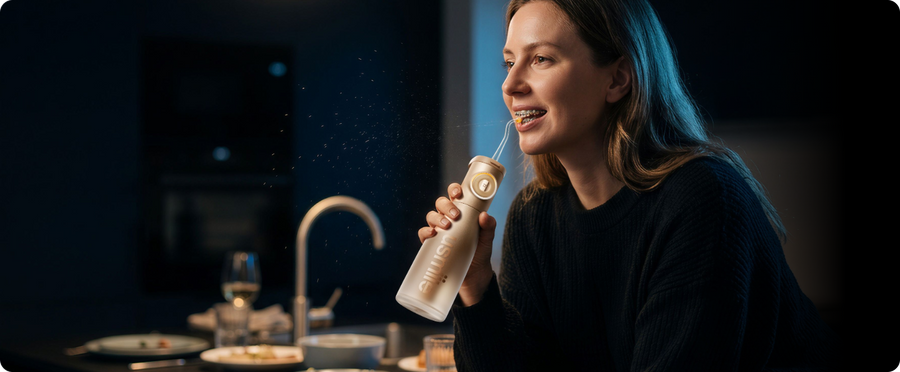





The "Golden Trio" of Braces Care: Why Microbubble Flow, 120-Second Runtime & an S-Shaped Ortho Nozzle Belong Together

On This Page
Quick Answer
What makes a water flosser for braces effective enough to clean brackets and archwires in one go without hurting tender gums? While any basic water flosser can rinse loose crumbs between normal teeth, the Orthodontic “Golden Trio” combines Pressurized Microbubble Flow, a 120-second continuous runtime, and an S-shaped slim-bristle orthodontic nozzle to pair gentle rinsing, extended cleaning time, and physical sweeping around brackets and archwires.
Missing even one of these three elements is why so many braces wearers still find plaque clinging to their brackets—or abandon their portable flosser halfway through treatment.
Why Standard Cordless Water Flossers Fall Short on Braces (The Three Hardware Bottlenecks)
Buying a generic portable water flosser when you get braces often leads to immediate frustration. Standard handheld units are engineered for smooth, unobstructed tooth surfaces—not an intricate metal or ceramic obstacle course of brackets, archwires, tie-wings, elastic ligatures, and molar bands. When you use a regular portable flosser on orthodontic hardware, you run straight into three design bottlenecks.
1. The 45-Second Refill Trap (Why Braces Take Twice as Long as Natural Teeth)
Cleaning natural teeth with a water flosser takes about 45 to 60 seconds because you only need to trace along the gumline and pause briefly between teeth. Fixed braces completely change that math. A full orthodontic arch spans 28 to 32 teeth, and every single bracket creates four distinct shelves—top, bottom, left, and right—plus the tight channel directly underneath the archwire.
When you pause for just 1 to 2 seconds per tooth to flush above the wire, under the wire, and around the gumline, a thorough orthodontic clean takes 90 to 120 seconds of continuous water flow. Most conventional cordless water flossers carry small 150ml to 207ml reservoirs that run completely dry in 30 to 45 seconds. That means stopping halfway through your upper arch with water dripping down your chin to refill the tank two or three times per session—an interruption that causes many teenagers and busy adults to rush or skip back molars altogether.
2. The Straight-Nozzle & Round-Jet Blind Spot
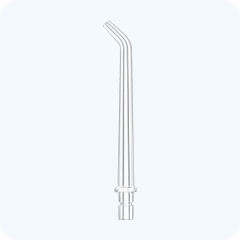
Fluid dynamics behave differently when water hits a bracket. A standard water flosser nozzle shoots a single, narrow cylindrical stream from a nearly straight neck. When that single jet hits the flat front face of a metal or ceramic bracket, much of the water simply deflects outward rather than penetrating the recessed undercut between the archwire and the enamel.
Even worse, sticky starchy dough and dental plaque biofilm adhere stubbornly to the corners of bracket tie-wings where water pressure alone cannot peel them off without physical bristle contact. Meanwhile, trying to angle a traditional straight-necked nozzle at a true 90-degree angle behind your back molar bands or wisdom-tooth pockets forces you to twist your wrist and elbow into awkward positions against the bathroom mirror.
3. The Biological Stakes: The 4-Week White Spot Lesion Clock
Leaving those bracket corners and under-wire blind spots half-cleaned carries a fast-moving biological cost. Brackets and wires block your tongue, cheeks, and saliva from naturally washing food particles away, creating sheltered stagnation zones right against your tooth enamel.
While a typical cavity on a smooth tooth takes months to develop, chalky white spots on teeth from braces—the square decalcification outlines left behind when plaque acid strips minerals from enamel—can appear much faster. A study published in The Angle Orthodontist notes earlier research reporting visible white spot lesions around brackets within approximately four weeks. Plaque along the gumline can also contribute to swollen, bleeding gums. In that study, visible white spot lesions affected 46% of the study's 12-month group.
Inside the “Golden Trio” of Braces Care: How Microbubble Flow, 120-Second Runtime & an S-Shaped Ortho Nozzle Work Together
To clean orthodontic hardware completely in a single pass, water texture, reservoir endurance, and nozzle geometry cannot work in isolation—they have to function as an integrated system.
Pillar 1 — Pressurized Microbubble Flow: Lifting Sticky Biofilm Without Stinging Tender Gums
Instead of firing a sharp, needle-like column of water that stings tender gums, Microbubble Flow infuses microscopic air bubbles into a high-frequency pulsed water stream (operating at roughly 1,400 pulses per minute). When these pressurized microbubbles collapse against brackets and interdental spaces, they create gentle micro-turbulence that disrupts sticky plaque biofilm and flushes out trapped food debris across a wider surface area.
That air-cushioned feel is critical during the first three to five days after an orthodontic wire tightening, when teeth are sore and even light pressure feels intense. Pairing microbubble technology with 10-level graduated pressure control from 30 to 120 PSI lets you drop down to a soothing 30 to 40 PSI on adjustment days, then step up in smooth 10 PSI increments to 90 or 120 PSI for heavy post-meal cleaning once tenderness fades.
Pillar 2 — 120-Second Continuous Flow: Countertop Endurance in a 300ml Cordless Body
Microbubbles can only protect your enamel if you have enough water to reach every bracket in your mouth. In the past, getting 90 to 120 seconds of runtime meant keeping a bulky 600ml plug-in tank on your bathroom counter.
By using a patented High-Speed Vortex Expansion Pump that optimizes air-water mixing and fluid efficiency, a compact 300ml detachable cordless reservoir can now deliver up to 120 seconds of uninterrupted flow. That is about 2.7 times the runtime of a standard 45-second portable flosser—giving you 45 seconds for your upper brackets, 45 seconds for your lower brackets, and a full 30 seconds to flush behind back molar tubes and lingual surfaces on a single tank.
Pillar 3 — The S-Shaped Slim-Bristle Orthodontic Nozzle: Mechanical Sweep Meets Ergonomic Reach
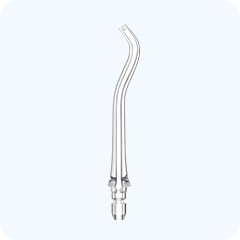
Even the best water stream needs mechanical help when sticky food paste or matured plaque clings to bracket tie-wings. An Upgraded S-Shaped Orthodontic Nozzle with Slim Bristles completes the Golden Trio by solving two mechanical problems at once:
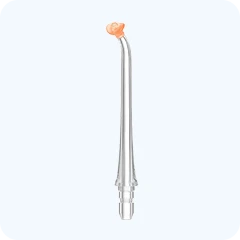
- Physical Micro-Bristle Scrubbing: Fine, tapered bristles at the tip of the nozzle reach directly underneath the archwire and around bracket pads, physically sweeping softened plaque loose at the exact instant the microbubble stream flushes it out of your mouth.
- Patented S-Curve Ergonomics: Unlike traditional straight tips, the double-curved S-shaped neck follows the natural contour of your jaw and cheek, allowing the nozzle tip to meet back molar bands and inner tongue-side surfaces at a clean 90-degree angle without awkward wrist bending.
| Hardware Configuration | Plaque & Sticky Paste Removal on Brackets | Full-Mouth Braces Coverage (28–32 Teeth) | Back-Molar & Under-Wire Reach | Gum Comfort After Wire Tightenings |
|---|---|---|---|---|
| Microbubbles + Straight Tip + 45s Tank | Moderate: Gentle stream, but lacks bristles to sweep sticky bracket corners | Incomplete: Runs out of water halfway; requires 2–3 refills | Difficult: Straight nozzle requires awkward wrist twisting at back molars | Good (cushioned stream, though often limited to 3–5 modes) |
| Ortho Bristle Tip + Standard Jet + 45s Tank | Good on front brackets, but sharp jet can feel harsh on inflamed gums | Incomplete: 207ml tank empties in ~45 seconds during bracket-by-bracket pauses | Moderate: Standard slight bend struggles with deep posterior molar tubes | Limited: Typically only 3 coarse pressure jumps |
| 600ml Countertop Unit + 10 Settings + Corded Hose | High when used with an orthodontic brush tip | Complete: 90+ seconds of runtime covers the whole mouth | Tethered: Hose and base unit restrict movement and cannot travel | High: 10 pressure settings, though standard pulse stream lacks microbubble cushion |
| The Complete “Golden Trio” (Microbubble Flow + 120s Vortex Tank + S-Shaped Ortho Nozzle) | Superior: Microbubbles + slim bristles lift and sweep >99.99% of lab-tested debris | Complete: Up to 120s continuous flow from a single 300ml cordless fill | Effortless: Patented S-curve meets back molars and lingual wires naturally | Optimal: Cushioned microbubbles + 10 precise settings (30–120 PSI) |

Countertop vs. Cordless Water Flossers for Braces: How Leading Models Compare
When comparing a water flosser braces setup, patients and parents have traditionally been forced into a frustrating compromise: buy a powerful countertop unit that hogs bathroom counter space, or settle for a travel-friendly cordless model that runs out of water in 45 seconds.
Why Braces Wearers Traditionally Had to Choose Between Power and Portability
Orthodontists have long recommended plug-in countertop irrigators—such as the Waterpik Aquarius WP-660—because their 600ml+ tanks and 10 pressure settings gave patients enough time and control to clean around brackets. Yet in real life, corded countertop machines take up valuable space on small apartment or family vanities, require a wall outlet right by the sink, use internal hoses that are tough to dry, and stay behind whenever you go to school, the office, or on vacation.
Conversely, first-generation cordless models shrank the body by sacrificing the exact features braces wearers need most—cutting runtime down to 45–60 seconds and stripping pressure control down to just 3 settings.
Meet the usmile C50: Pro-Level Braces Care Without the Countertop
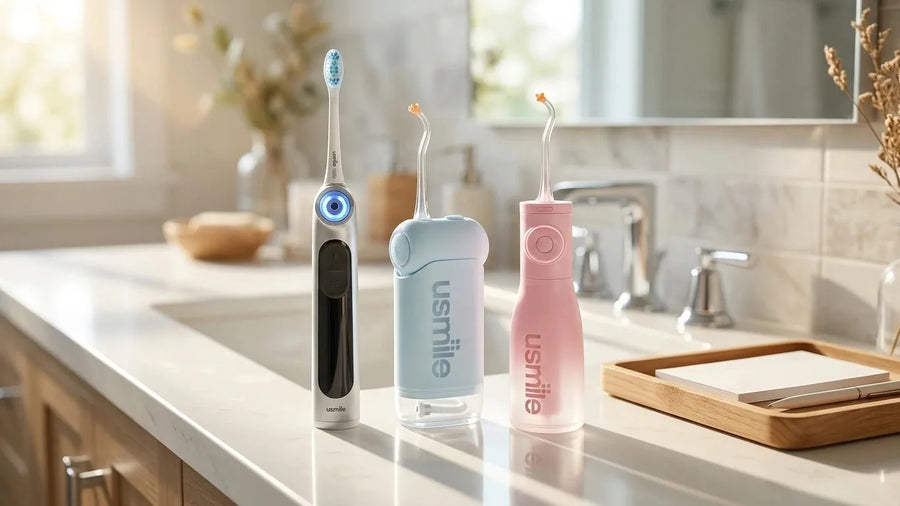
Engineered specifically to eliminate that trade-off, the usmile C50 Portable Dental Flosser (Pro-Level Braces Care. Without the Countertop., MSRP $99.00 USD in Bronze Gold and Obsidian Black) brings full countertop performance into an all-in-one cordless body:
[[Product Card]]
- ADA Seal of Acceptance & Clinically Proven Efficacy: The usmile C50 carries the official American Dental Association (ADA) Seal of Acceptance. In third-party laboratory testing on tooth models, it achieved >99.99% food debris removal and 99.67% plaque removal within 3 seconds on tested areas. In third-party human consumer testing, the C50 delivered 3× the immediate plaque-cleaning efficacy and 2.2× the immediate soft-debris cleaning efficacy of traditional string floss—and among tested adolescent users (ages 9–17), it improved immediate soft-debris cleaning by 93.94% and plaque cleaning by 73.77% with zero adverse reactions, backed by a 28-day hospital clinical evaluation report demonstrating significant reductions in plaque and gingival bleeding indices.
- 300ml Vortex Reservoir With Up to 120s Continuous Flow: Powered by usmile's patented High-Speed Vortex Expansion Pump, the 300ml tank delivers up to 120 seconds of continuous cleaning, matching or outlasting a 600ml countertop machine without a single refill.
-
10-Level Smart Pressure Control (30–120 PSI): An intelligent pressure-stabilizing chip maintains steady output—even as battery levels drop—across 10 precise settings in 10 PSI increments (
30, 40, 50, 60, 70, 80, 90, 100, 110, and 120 PSI) with instant LED button and gear feedback. - 3 Patented S-Shaped Nozzles in the Box: Includes the Upgraded S-Shaped Orthodontic Nozzle with Slim Bristles, the S-Shaped Guidance Nozzle, and the S-Shaped Standard Nozzle for effortless access to posterior blind spots.
- Hygienic Tubeless Waterway & 60-Day Battery Life: Built with FDA food-grade BPA-free materials, the C50 eliminates the mold-prone internal suction tube found in traditional handheld flossers, pairing an antimicrobial water path with a wide removable tank that rinses and air-dries effortlessly after daily use, IPX7 full waterproofing, and up to 60 days of battery life via USB Type-C.
| Model | Form Factor | Water Flow Technology | Tank Capacity & Continuous Runtime | Pressure Settings | Orthodontic Nozzle Design | Battery Life | Official Price & Authority Backing |
|---|---|---|---|---|---|---|---|
| usmile C50 Portable Dental Flosser | Cordless All-in-One Handheld | Pressurized Microbubble Flow (1,400±200 pulses/min) | 300ml / Up to 120 seconds (Vortex Expansion Pump) | 10 Levels (30–120 PSI in 10 PSI steps) | Patented S-Shaped Slim-Bristle Ortho Nozzle (+2 S-Nozzles) | Up to 60 Days (USB Type-C) | $99.00 USD | ADA Accepted, 28-Day Clinical Report, 3× Plaque Removal vs. Floss |
| Waterpik Cordless Advanced 2.0 | Cordless All-in-One Handheld | PrecisionPulse (1,250 pulses/min) | 207ml / Up to 45 seconds | 3 Levels | Straight-neck Orthodontic Tip included (4 tips total) | Up to 4 Weeks (Magnetic charger) | $99.99 USD | ADA Accepted; claims up to 3× plaque removal around braces |
| Panasonic EW1511 | Cordless All-in-One Handheld | Ultrasonic Microbubble (up to 1,600 pulses/min) | 200ml / ~60 seconds | 5 Levels | Rotating standard nozzle (no dedicated bristle ortho tip highlighted) | ~10 mins continuous (~10–14 days) | ~$99–$130 USD | Focuses on general periodontal/ortho care |
| Philips Cordless Power Flosser 3000 | Cordless All-in-One Handheld | Quad Stream + Pulse Wave | 250ml / ~60 seconds recommended | 2 Modes × 3 Intensities | F1 Standard + F3 Quad Stream (no bristle ortho tip) | Up to 14 Days (USB-C) | ~$89.99–$99.99 USD | ADA Accepted; general interdental focus |
| Waterpik Aquarius WP-660 | Plug-In Countertop Base + Hose | Pulsating Stream (1,400 pulses/min) | 651ml / 90+ seconds | 10 Levels + 2 Modes | Straight-neck Orthodontic Tip included (7 tips total) | Plug-in AC Wall Power Only | $99.99 USD | ADA Accepted; countertop benchmark |
How to Brush Teeth With Braces and Use a Water Flosser: The Complete 4-Minute Daily Routine
Owning the right water flosser with braces is most effective when you pair it with the proper brushing sequence. Many orthodontic patients accidentally reduce their fluoride protection by doing their routine in the wrong order.
Step 1 — Why You Should Water Floss Before Brushing With Braces
When you wear braces, water flossing before you brush gives your enamel a major advantage. Food particles, starchy paste, and thick plaque packed underneath your archwires act like a physical shield that blocks toothbrush bristles and toothpaste from reaching the tooth surface.
By running a 2-minute Golden Trio water flossing pass first, you clear away trapped food and sweep sticky biofilm out of bracket undercuts. When you follow up with your toothbrush, the fluoride in your toothpaste can directly coat the bare enamel framing each bracket. Brush for two minutes twice daily with fluoride toothpaste. Just as importantly, water flossing first means you won't wash away that protective layer of concentrated fluoride with a heavy water jet right after brushing.
Step 2 — The 2-Minute “Golden Trio” Water Flossing Sequence (0:00–2:00)
- 0:00–0:15 | Prep Lukewarm Water & Match Your PSI: Fill the 300ml tank with lukewarm tap water and click in the S-Shaped Slim-Bristle Orthodontic Nozzle. Start at the lowest pressure setting and increase only as comfortable, following your orthodontist's advice and the device instructions.
- 0:15–1:00 | Upper Arch Sweep (Back Molars to Front): Place the S-shaped tip in your mouth before pressing the power button, lean over the basin, and keep your lips slightly parted so water drains smoothly along the corner of your mouth into the basin without splashing. Starting at your upper back molar band, aim at a 90-degree angle to the gumline. Pause for 1 to 2 seconds per tooth, letting the slim bristles gently sweep around all four bracket wings and directly under the archwire before gliding to the next bracket.
- 1:00–1:45 | Lower Arch Sweep (Back Molars to Front): Follow the same back-to-front path across your bottom brackets and elastic hooks, where gravity and saliva naturally pool food debris.
- 1:45–2:00 | Posterior Tubes & Lingual Surfaces: Use the natural curve of the S-shaped nozzle to flush behind your back molar tubes and along the inside (tongue-facing) surfaces of both arches.
Step 3 — How to Brush Teeth With Braces: The 2-Minute 45-Degree Two-Angle Technique (2:00–4:00)
Once your brackets and wires are flushed clean, follow this dentist-recommended technique for how to brush teeth with braces:
- Start With Fluoride Toothpaste on a Soft Brush: Place a pea-sized amount of fluoride toothpaste on a soft-bristled manual or sonic electric toothbrush. Avoid whitening toothpastes while in braces, as whitening agents only lighten exposed enamel and can leave uneven two-tone squares when brackets are removed.
- Angle 1 — 45 Degrees Downward Above the Wire: Place the bristles against your gumline above the brackets and tilt the brush at a 45-degree angle pointing downward toward the top edge of the bracket pad and wire. Use gentle, short circular vibrations for 2 to 3 seconds per tooth across the entire arch.
- Angle 2 — 45 Degrees Upward Below the Wire: Tilt the brush head at a 45-degree angle pointing upward from the biting edge so the bristles slide underneath the archwire and clean the bottom shelf of each bracket.
- Brush Chewing & Tongue Sides, Then Spit Without Rinsing: Brush the chewing surfaces of your molars and the inside surfaces of your teeth. When you finish, spit out the excess foam—and avoid rinsing vigorously with water so a thin film of fluoride stays on your enamel overnight.
[[Collection Card]]
When to Add String Floss or Call Your Orthodontist (Safety Boundaries)
While using a water flosser for braces helps flush food debris and clean around brackets, clean between your teeth every day using waxed string floss with a threader or another interdental aid recommended by your orthodontist. Never use wooden toothpicks, fingernails, or metal pins to pry stubborn food out from under a wire. If a bracket feels loose or spins on the archwire, cover it with orthodontic wax and call your orthodontist for a repair.

Frequently Asked Questions About Using a Water Flosser With Braces
1. Will lukewarm water bend heat-activated braces wires or loosen bracket glue?
No. Comfortable lukewarm water is generally suitable for routine cleaning with braces. Heat-activated nickel-titanium (NiTi) archwires respond to temperature, but this does not mean ordinary lukewarm water will permanently damage them. Follow your orthodontist's appliance-care advice and the flosser's water-temperature instructions. Avoid pouring boiling or scalding water into the reservoir, which can injure oral tissue and damage the device.
2. Can I put mouthwash in my water flosser tank, and how do I keep the waterway from growing mold?
Only if the manufacturer's instructions permit it. Use only compatible mouthwash and follow the specified dilution and flushing instructions; do not assume every alcohol-free fluoride or antibacterial mouthwash is suitable for the pump. To help prevent buildup, rinse the reservoir and allow it to air-dry after use. The usmile C50 Portable Dental Flosser eliminates the internal rubber tube entirely, combining a tubeless antimicrobial waterway and FDA food-grade BPA-free materials with a wide detachable tank that pops off for quick rinsing and air-drying.
3. Should I take off my rubber bands (elastics) before water flossing, and can the stream knock off power chains?
Follow your orthodontist's instructions for removing and replacing removable inter-arch rubber bands (elastics) during cleaning. Do not remove fixed rubber ligature ties (O-rings) or connected power chains yourself. Start with low pressure, avoid forcing the tip against the appliance, and contact your orthodontist if a tie, chain, or bracket becomes loose.
4. Why do my gums bleed the first few times I use a water flosser with braces?
Light gum bleeding can be associated with plaque-related inflammation, but excessive pressure or incorrect technique can also irritate the gums. Select Level 1 or 2 (30 to 40 PSI) on the usmile C50 and use gentle technique. Stop if the stream causes pain or injury, and ask your dentist or orthodontist about persistent bleeding. Heavy bleeding, swelling, or worsening pain should be assessed promptly rather than waiting two weeks.
5. How often should I replace the S-shaped orthodontic bristle nozzle, and what are the other two nozzles in the box for?
Because the fine tapered bristles on the Upgraded S-Shaped Orthodontic Nozzle physically brush against metal or ceramic brackets every day, follow the manufacturer's replacement interval and replace the nozzle sooner if the bristles splay outward. Alongside the orthodontic tip, the usmile C50 includes two additional S-shaped nozzles in the box: the S-Shaped Guidance Nozzle (which helps beginners and teens maintain a steady angle along the gumline) and the S-Shaped Standard Nozzle (ideal for general interdental cleaning or post-braces care).
6. My teen hates floss threaders and splashes water all over the mirror—can they use the usmile C50 in the shower?
An IPX7 rating alone does not confirm suitability for shower use. Although the usmile C50 features an IPX7 waterproof rating and a cordless all-in-one body, use it in the shower only if the manufacturer's instructions explicitly permit it, and never use it while charging. To reduce splashing at the sink, place the nozzle in the mouth before switching it on, lean over the basin, and keep the lips slightly parted so water can drain.
7. Will an orthodontic water flosser still be useful after my braces come off?
Absolutely. When your fixed brackets come off, your orthodontist will often bond a permanent lingual retainer wire across the back of your front teeth—a spot that collects tartar rapidly and normally requires floss threaders all over again. By switching from the orthodontic bristle tip to the included S-Shaped Standard Nozzle, you can use the ergonomic S-curve to flush behind permanent retainers, around emerging wisdom-tooth flaps, and around crowns or bridges for years after debonding day.
8. Can I pack the usmile C50 for school, work, or air travel without carrying a bulky charging base?
Yes. Weighing 324.8g (excluding the nozzle), the usmile C50 fits easily into a backpack or toiletry bag. Its 2500mAh lithium battery lasts for up to 60 days on a single charge (and up to 80 days in internal lab testing) and recharges via a standard USB Type-C cable, so you can leave proprietary magnetic docks at home. For air travel, check your airline's current lithium-battery rules and the device's charging requirements before packing.
Upgrade Your Braces Routine With the Complete “Golden Trio”
Keeping your brackets, wires, and gums healthy doesn't have to mean choosing between a 20-minute struggle with floss threaders, a 45-second portable flosser that runs dry halfway through, or a bulky machine that takes over your bathroom sink. When Pressurized Microbubble Flow, a 120-second continuous runtime, and a patented S-shaped slim-bristle orthodontic nozzle work together inside one cordless device, a complete orthodontic clean takes just two effortless minutes.
Ready to bring countertop power and 10-level custom comfort to your daily braces care? Explore the ADA-Accepted usmile C50 Portable Dental Flosser to keep every bracket and wire spotless from your first archwire to the day your braces come off.
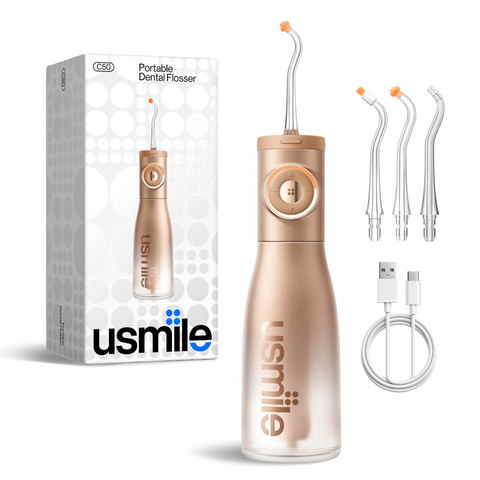
usmile C50 Portable Dental Flosser [Pre-order | Estimated Shipping: Nov 5]
MaxClean Efficiency Flow - Deep cleans hidden back teeth vwith the power of a countertop device.
View product
Portable Water Flossers & Oral Irrigators
From an easy first clean to ultra-portable power and pro-level control, find the water flosser built for your routine.
Water FlosserDisclaimer
The information in this article is provided for general educational purposes only and is not a substitute for professional orthodontic or dental advice, diagnosis, or treatment. Always follow the specific appliance-care instructions provided by your licensed orthodontist or dentist, and contact your dental office promptly if you experience a loose bracket, poking wire, or persistent gum swelling.