


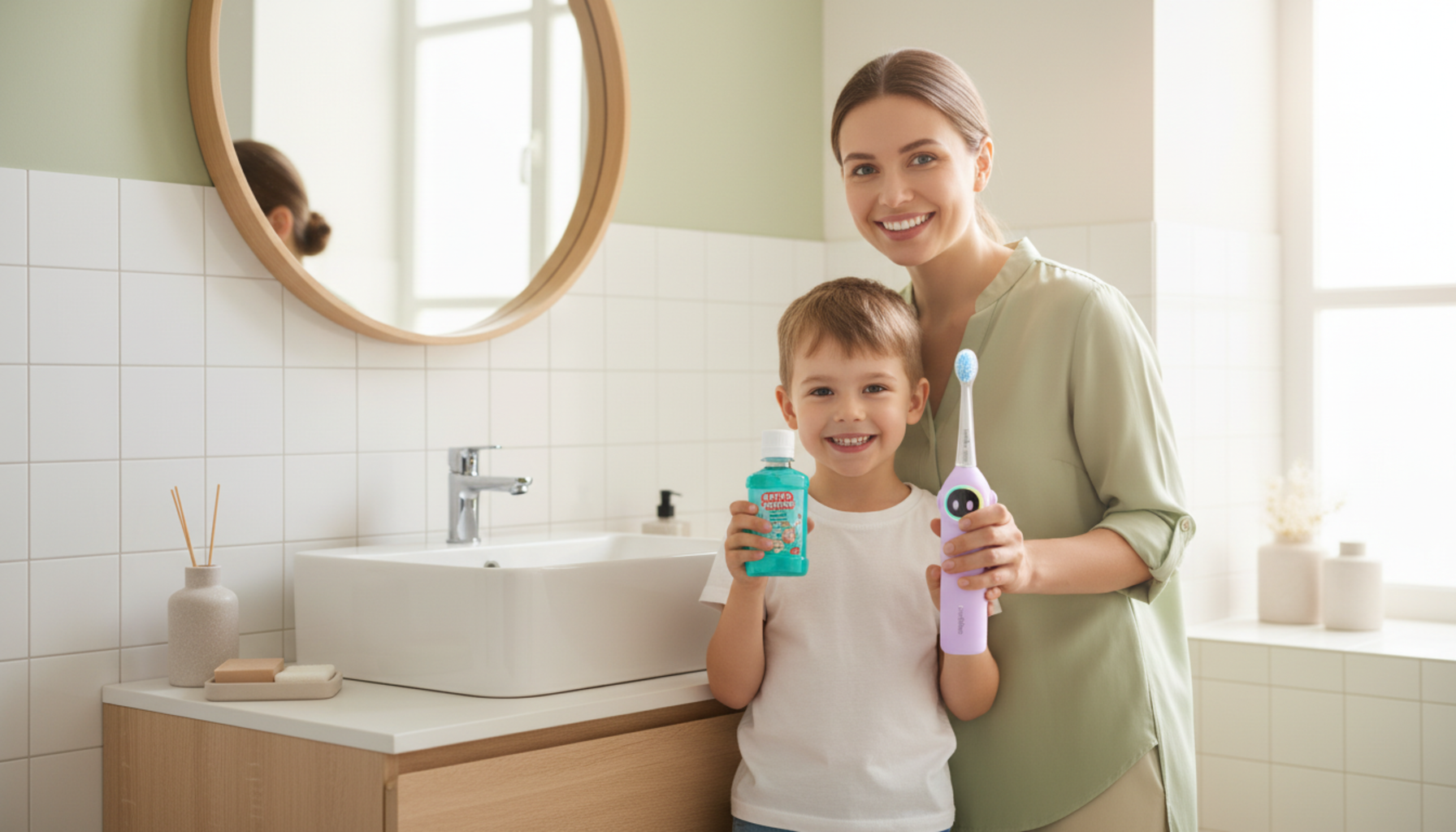
Can Kids Use Mouthwash? What Parents Should Know
Kids can use mouthwash — but age matters more than most parents expect. If you're wondering "can kids use mouthwash?", the short answer from theAmerican Dental Association is yes, starting at age 6. The reason is practical: children under that age tend to swallow mouthwash rather than spit it out, and repeated ingestion of fluoride while permanent teeth are still forming causes fluorosis. White spots or streaks on adult teeth that show up when they erupt and don't disappear.
After 6, an alcohol-free kids' formula used after brushing and flossing is a solid addition. Cavity protection, fresher breath, and real benefit if they wear braces. Getting it right mostly comes down to the age, the product, and one quick readiness check — this guide covers all three.
Can Kids Use Mouthwash?
Why Kids Under 6 Need to Wait

The American Dental Association has held the same position for years: no mouthwash for children under 6, unless a dentist has a specific reason to recommend otherwise. The problem isn't the mouthwash itself — it's that young children haven't developed the reflexive control to reliably spit out liquid rather than swallow it. And colorful, berry-flavored, kid-friendly packaging basically invites a 4-year-old to treat it like a drink. Because to them, that's exactly what it looks like.
When it comes to mouthwash safety for kids, swallowing even small amounts can cause stomach upset and nausea, while larger amounts become more serious. The longer-term concern, however, is fluorosis. Most kids' mouthwashes contain fluoride, which is genuinely beneficial in brushing-and-spitting quantities. Swallowed consistently while adult teeth are still forming under the gums, though, it can alter how the enamel of those teeth develops — and they later erupt with permanent white spots or streaks. Cosmetically permanent. Not painful, doesn't affect the tooth's health. But there for life.
Age Isn't the Whole Story
A 6-year-old who still swallows half the water during a rinse test isn't ready for mouthwash. The birthday doesn't change that. Developmental readiness — being able to spit reliably — is the actual determining factor.
At what age can kids start using mouthwash?
Under Six — Just Skip It
Babies, toddlers, preschoolers: no mouthwash. The right routine at this age is brushing twice daily with the correct amount of fluoride toothpaste — rice-grain-sized under age 3, pea-sized from 3 onward — with a parent doing most of the work, and flossing as soon as any two teeth touch. That's the whole thing. Mouthwash adds nothing at this stage that justifies the risk of swallowing.
Six to Twelve — Yes, With You Watching

This is where mouthwash can enter the picture, carefully. Children in this range may use an alcohol-free kids' formula after passing the water test — but with a parent present. Even a child who handles the water test perfectly can slip up with actual mouthwash the first few times. The different texture, the mild tingle of even a gentle formula — it's a new experience. Stay in the room. Pairing a mouthwash habit with a good children's sonic toothbrush makes the whole routine work — the rinse supplements teeth that have actually been brushed, not as a shortcut around it.
Teens — Honestly, This Is Where It Makes Most Sense
Teenagers are the ones who really earn mouthwash its place. Especially for teens with braces. Brackets and wires create food traps that even dedicated brushing can't fully reach. Every meal leaves debris behind, and mouthwash helps disrupt it while delivering fluoride to the hard-to-reach spots created by orthodontics. Self-consciousness about breath becomes very real at this age, too, and a consistent rinse fits naturally into the kind of independent routine teenagers actually want to maintain.
When to Check With the Dentist First
Braces, recurring cavities, dry mouth, a strong gag reflex, mouth sores, and swallowing difficulties — any of these, ask before introducing mouthwash. A dentist who knows your child's specific dental picture is better positioned to advise on the right product and frequency than any label.
Why Mouthwash Can Be Risky for Young Children
Swallowing Is the Real Problem
Kids' mouthwash is designed to appeal to children — colorful, sweet, fun packaging. It works. It also means young children treat it like a drink, particularly when no adult is watching. Store it where young children genuinely cannot access it, not just on a shelf but somewhere that requires actual adult effort to reach. If a large amount does get swallowed, call poison control. Some pediatric dentists suggest drinking milk immediately — calcium can bind to fluoride and limit absorption — but contact a professional rather than relying on that alone.
Fluorosis — The Thing Nobody Explains Until After

Fluoride in toothpaste, in appropriate amounts, is safe and beneficial from the moment teeth appear. The issue with mouthwash is the swallowed dose — fluoride reaching developing tooth structures beneath the surface, repeatedly over time. Too much during the forming window changes how enamel develops, and those teeth later erupt with permanent discoloration. White spots in milder cases, surface irregularities in more significant ones. The risk window is roughly under age 8, when most permanent teeth are still developing beneath the gums. After the eruption, that window closes.
Worth saying clearly: fluorosis is cosmetic. The teeth aren't weakened or made more vulnerable. The spots are just there, permanently.
Alcohol in Mouthwash — This One's Simple
Many adult mouthwashes contain alcohol. It's a preservative, a carrier for flavor compounds, and the source of that burning sensation. None of that belongs in a child's mouth — it dries out oral tissue, disrupts the mouth's natural pH, and is a genuinely harsh ingredient for a growing child. Children's mouthwash must be explicitly alcohol-free. Not probably alcohol-free. Check the label directly.
The One Risk Nobody Talks About Enough
Mouthwash produces a sensation of cleanliness that is more immediately satisfying than brushing. The mouth feels fresh, breath is noticeably better, and they feel finished. Kids notice this. Adults do too, to be honest. The problem is that mouthwash doesn't remove plaque — only the mechanical action of a toothbrush does. If a child starts treating the rinse as sufficient, or pushes back on brushing because they have already rinsed, the mouthwash has created a net negative effect on their oral health rather than a benefit.
What Mouthwash Actually Does for Ready Kids
Used correctly — always after brushing and flossing, never as a substitute — mouthwash does add real value. According to the ADA's guidance on whether kids can use mouthwash, appropriately used fluoride rinsesprovide school-age children with meaningful protection against tooth decay.
An Extra Round of Cavity Protection
Toothbrushes are good. Not perfect. The bristles hit the main surfaces fine, but those tight gaps between teeth? The back of the last molar? The spot right where the tooth meets the gum? Those areas get missed — every single time — no matter how carefully your child brushes.
That's exactly where fluoride mouthwash earns its place. After brushing, the rinse moves through all those hard-to-reach spots and coats the enamel with another layer of fluoride. More contact time. More surface coverage. More protection where the brush left off.
Research backs this up clearly. A study conducted with school-age children found that those who rinsed with fluoride mouthwash regularly had about 50% fewer cavities than peers who did not — a meaningful drop, not a small one. From a habit that takes 30 seconds before lights out. That number alone is reason enough to add it to the routine.
It Freshens Breath — For an Hour or So

Once kids hit school age, they start noticing things. Their breath is one of them. Mouthwash does help with that — it knocks back the bacteria causing the smell and clears out some of the stale compounds sitting in the mouth. Swish for 30 seconds, spit, done. Breath is noticeably better. That part is real.
What nobody really tells you is how quickly it wears off. An hour, maybe two. After that, whatever was causing the smell in the first place is still sitting there doing its thing.
So if your kid's breath is bad every morning, or it keeps coming back throughout the day, the mouthwash isn't solving anything — it's just putting a lid on it temporarily. The actual cause could be a dozen different things. They might not be scrubbing their tongue at all. Could be dry mouth from breathing through their nose at night. Could be a cavity that hasn't been caught yet. Sometimes it's just diet — a lot of dairy, sugary snacks all day, garlic-heavy dinners. All of those keep the smell coming back, no matter how much rinsing happens.
If it's a pattern, bring it up with your dentist. A rinse won't fix what's underneath.
Braces Are the Strongest Argument for It
Talk to any parent whose kid just got braces, and they'll tell you the same thing — keeping those teeth clean suddenly becomes a whole different job. Brackets catch everything. Wires create little ledges where food just sits. You can hand your child the best toothbrush money can buy, spend five minutes coaching them through it, and still find something wedged in there when they smile at you afterward.
A fluoride rinse cuts through that. It gets into the spaces around the brackets, breaks up what's sitting there, and pushes fluoride into surfaces that the brush could barely touch. Before braces, mouthwash is a smart addition to the routine. After the braces go on, it's no longer optional. The hardware itself makes it necessary.
While the brushing technique is still developing
If you've ever actually watched a young child brush their teeth — really watched, not just assumed it's happening — you already know what's going on in there. Front teeth get attention. Maybe the sides. The back molars get a couple of half-hearted strokes. The whole thing wraps up in under a minute, sometimes under 45 seconds. Then they look up like they've done something impressive.
Nobody's blaming them. That level of coordination and patience takes years to develop. But while it's developing, a fluoride rinse quietly does some useful work. It reaches the spots the brush skimmed over, coats the enamel with another layer of protection, and rinses out loose debris that would otherwise just sit there all night. It won't fix poor brushing on its own — nothing does except practice — but as a stopgap while technique is still coming together, it pulls its weight.
What Type of Mouthwash Is Safe for Kids?
Alcohol-Free — Not Negotiable
Most of what fills the mouthwash aisle is built for adults. Those bottles contain alcohol — sometimes a significant amount. That's fine for a grown-up. It is not fine for a child, and it's not something you want anywhere near your kid's nightly routine.
Every mouthwash you buy for your child needs to be alcohol-free. Not probably alcohol-free. Not the same brand you bought six months ago without checking. Alcohol-free, confirmed on the ingredient list, every time. Formulas get quietly updated. Labels get redesigned. A bottle that looks identical to last year's version might not contain the same formula. The words "for kids" printed across the front tell you nothing about what's actually in it. Flip it over. Read the back. Then buy it.
Fluoride Formulas Once They Can Spit
There's one thing that has to happen before a fluoride rinse enters the picture: your child needs to be able to spit. Reliably. Without you standing there reminding them. Without half of it going down the throat anyway. Most kids get to that point somewhere around age 6, but plenty aren't quite there until 7, and that's completely fine.
Once spitting is genuinely under control, a children's fluoride rinse is worth adding in. Look for sodium fluoride as the active ingredient — that's what you want — at a concentration made specifically for children, not a diluted adult formula. And follow the dosage on the label for your child's exact age range. Not the next age group up. Not a larger amount because they've been using it for months. With fluoride, the right dose is the right dose, and the label already did the math for you.
The Age Range on the Label Is a Formulation Difference
Products labeled for 6 and up aren't appropriate for a 4-year-old. The age ranges on kids' mouthwash reflect actual differences in fluoride concentration and assumptions about swallowing control — not just marketing. Follow them.
The ADA Seal Is Worth Looking For
The ADA evaluates oral care products for safety and effectiveness. A product with the ADA Seal has been tested and meets established standards. Easy check to make at the shelf.
Skip Whitening Rinses and Adult Formulas
Children don't need whitening mouthwash. They don't need strong antiseptic formulas for adults either. Mild children 's-specific products — that's the whole criterion.
How to Tell If Your Child Is Actually Ready
Try the Water Test First
Have your child take a sip of water, swish for a full 30 seconds, and spit every drop into the sink. Not some of it — every drop. If they can do this reliably, every time you ask, they're probably ready for mouthwash. If they swallow some water during the test, wait a few months and try again. The test tells you more than the age does.
Stay in the Room for the First Several Sessions
Children who pass the water test can still swallow mouthwash when they're tired or distracted, and the first few sessions are when that's most likely to happen. Don't walk away. Remind them that, for the first few weeks, before each use, this is swish-and-spit. It's worth the repetition.
Store It Away From Younger Siblings
Sweet-flavored and colorful, it looks drinkable — because in a child's world, it basically is. Keep it somewhere onlyan adultcan reach, not just on a low shelf. If a large amount is swallowed, call poison control.
How Kids Should Use Mouthwash
The order of the routine matters more than most parents realize.
Brushing and Flossing Come First — Always

A toothbrush mechanically removes plaque — nothing replaces that physical contact. Floss cleans the contact zones between teeth. Mouthwash then rinses out loosened debris and applies fluoride to clean surfaces. Using it before brushing skips the actual cleaning and jumps to the finish. Starting with a solid electric toothbrush for children and proper brushing technique is what gives mouthwash something real to build on.
Follow the Dosage on the Label
2 to 5 teaspoons, depending on the product and age. Use a cup — don't let them pour freely. More isn't more effective.
Time It
Thirty seconds to a minute. A countdown timer works better than asking a child to count in their head while also not swallowing. Contact time with the tooth surface is where the fluoride does its work — spitting it at the 5-second mark defeats the point.
All of It Goes in the Sink
Set this expectation before every session — not just the first one. Ask them to confirm before moving on with the bedtime routine.
Skip the Water Rinse Immediately After
For fluoride rinses, rinsing with water immediately after reduces the fluoride's contact time with enamel. Unless the product label specifically says otherwise, wait a few minutes before rinsing.
Can Mouthwash Fix Bad Breath in Kids?

Temporarily, yes. Mouthwash cuts down the bacterial count in the mouth and neutralizes some odor-causing compounds. Your child's breath will be fresher. For about an hour, probably.
What it won't do is find the cause. And in children, the cause is usually not what parents expect. Dehydration is one of the most common problems when a child doesn't drink enough water, saliva production drops, and saliva is the mouth's natural defense against bacteria. Less saliva, more smell. Not cleaning the tongue is another frequent source. Bacteria settle on the tongue's surface just like plaque settles on teeth, and brushing doesn't reach the tongue unless it's deliberately included in the routine.
Recurring bad breath that doesn't respond to better brushing, tongue cleaning, and more water is worth a dental appointment. It can indicate a cavity, gum inflammation, sinus drainage, or other issues that no rinse will address.
Common Mistakes Parents Make With Kids' Mouthwash

Giving It Before They're Ready
Under 6, the risk of swallowing is real, and the fluorosis window is open. Wait unless a dentist has said otherwise for a specific reason.
Reaching for the Adult Bottle in the Bathroom
Adult mouthwash — even familiar brands you've used for years — is not the right formula for a child. Alcohol content, ingredient concentrations, flavor intensity: all calibrated for adult mouths. Keep children's and adult products separate.
Walking Away After a Few Good Sessions
There's a genuine difference between a child who can use mouthwash and one who can use it unsupervised reliably. Kids between 6 and 12 benefit from active supervision, especially in the evening. A child who performs perfectly during a calm supervised session can absolutely swallow mouthwash at 9 pm on a school night when they're half-asleep and trying to finish quickly.
Letting the Rinse Become the Whole Routine

Mouthwash feels complete. The whole mouth is covered, breath is fresher, and they feel done. Making the brushing step non-negotiable — and keeping up with soft-bristle replacement brush heads that actually clean properly rather than worn-out ones that just glide over surfaces — keeps mouthwash where it belongs: the final step, not a substitute for the work that came before it.
Assuming All Kids' Mouthwashes Are the Same
Different products have different age requirements, fluoride levels, and dosage instructions. A product fine for a 10-year-old may not be the right choice for a 7-year-old. Read the label on each new product rather than assuming the formula matches what you've used before.
FAQs
Why can't kids under 12 use Listerine?
Standard Listerine is an adult product — alcohol, essential oils, and concentrations designed for adult mouths. The label says as much. What Listerine also makes — and what's different — is Listerine Smart Rinse Kids, which is alcohol-free and formulated specifically for younger mouths. Those are not the same product, despite sharing the same brand name. If your family prefers Listerine, use the children's version. Read the label so you know which one you're actually buying.
Do dentists recommend mouthwash for kids?
Sometimes. Pediatric dentists may suggest it for children at higher risk of cavities, those with braces, those with dry mouth, or for areas that are structurally difficult to brush well. For a child who already brushes thoroughly twice daily and flosses consistently, mouthwash may not add much to what's already working. Ask at your child's next cleaning — the right answer depends on their specific oral health situation, not a general recommendation.
Can my 7-year-old use mouthwash?
Probably yes — if they pass the water swish-and-spit test reliably, use an alcohol-free children's formula, and have a parent present. Age 7 is within the right window for most kids. If the water test shows they still swallow some, give it a few months and test again. What the test shows matters more than the age.
Does mouthwash neutralize acid?
Certain rinses support enamel health or reduce bacterial activity, and some are specifically designed for acid protection. Rinsing with plain water after acidic food or drinks also helps — it washes acid off surfaces before it starts breaking down enamel. What mouthwash can't do is reverse erosion that's already happened. Visible sensitivity, enamel wear, or frequent exposure to acidic drinks: those are dentist conversations, not a mouthwash question.
Is Listerine good for a 7-year-old?
Listerine Smart Rinse Kids — the children's alcohol-free formula — is a reasonable option if the child meets the readiness criteria and follows the label instructions. Standard adult Listerine is not appropriate for a 7-year-old: same brand name, completely different product. When unsure, ask your child's dentist which specific formula makes sense for their age and situation.
What is the 2-2-2 rule for teeth?
Brush twice a day, for 2 minutes each time, and see the dentist twice a year. A useful minimum standard to keep in mind. Some children — those with higher cavity risk, active braces, or specific dental concerns — will need dental checkups more frequently than twice yearly. Their dentist will tell you if the standard schedule isn't enough.
What is the age limit for mouthwash?
The lower limit is what matters: children under 6 generally shouldn't use mouthwash unless a dentist has a specific clinical reason. Children over 6 who can reliably spit, use the right children's formula, and are supervised by a parent can safely add mouthwash to their routine. There's no upper age limit — it's appropriate for most people throughout life. With kids, the only limit that needs watching is the minimum, and it's about developmental readiness more than a fixed number.
|
Quick rules on when kids can use mouthwash:
Mouthwash has a real place in children's oral care at the right age. It just isn't a shortcut, and it isn't the main event. . |
Sources
- American Dental Association / MouthHealthy: Healthy Habits for Babies and Kids — ADA guidance on mouthwash age rules, fluoride toothpaste amounts, and children's oral care supervision.
- CDC: Oral Health Tips for Children — Brushing twice daily with fluoride toothpaste, parent assistance, and cavity prevention for children.
- CDC: Dental Sealant Facts — Cavity prevention statistics and sealant guidance for children's back teeth.
- KidsHealth: Keeping Your Child's Teeth Healthy — Age-based brushing, flossing guidance, fluoride standards, and dentist visit frequency.
- Healthline: mouthwash safety for kids — Clinical overview of kids' mouthwash, including age thresholds, ingredients, and safe use.
- American Academy of Pediatric Dentistry: Fluoride Therapy Guidelines — Clinical guidelines on fluoride use in children, including mouthwash and cavity prevention.
- NHS: How to Keep Your Teeth Clean — UK national guidance on brushing, fluoride use, and oral hygiene standards for children.


Looking for something else?
Best Electric Toothbrush for Teens (2026): Top Picks, Tested and Reviewed
LEARN MORE
Best Electric Toothbrush for Gum Disease (2026): 6 Picks Tested for Real Gum Protection
LEARN MORE
Electric Toothbrush on Plane: The Complete Travel Guide (2026)
LEARN MOREBest Sustainable Electric Toothbrush 2026: 5 Picks Tested for a Greener, Healthier Smile.docx
LEARN MORELooking for something else?
Best Sustainable Electric Toothbrush 2026: 5 Picks Tested for a Greener, Healthier Smile
LEARN MORE
Best Cheap Electric Toothbrush (2026): Top 5 Budget Picks That Actually Work
LEARN MORE
Ultrasonic Toothbrush vs Electric: Which Technology Wins for Your Smile?
LEARN MOREYou may also like
usmile Y20 PRO Upgraded AI Electric Toothbrush

usmile Q30 Kids Electric Toothbrush

usmile Q30 Kids Electric Toothbrush Trio Pack


usmile C30SE Portable Dental Flosser
Further reading
The 5 Toothbrushing Spots Kids Miss Most—and How Parents Can Help
The Back-to-School Brushing Reset: A 14-Day Plan for Kids Ages 3–8
Behind usmile D50 OralCam Toothbrush: From Motion Tracking to Visual Intelligence in Oral Care

